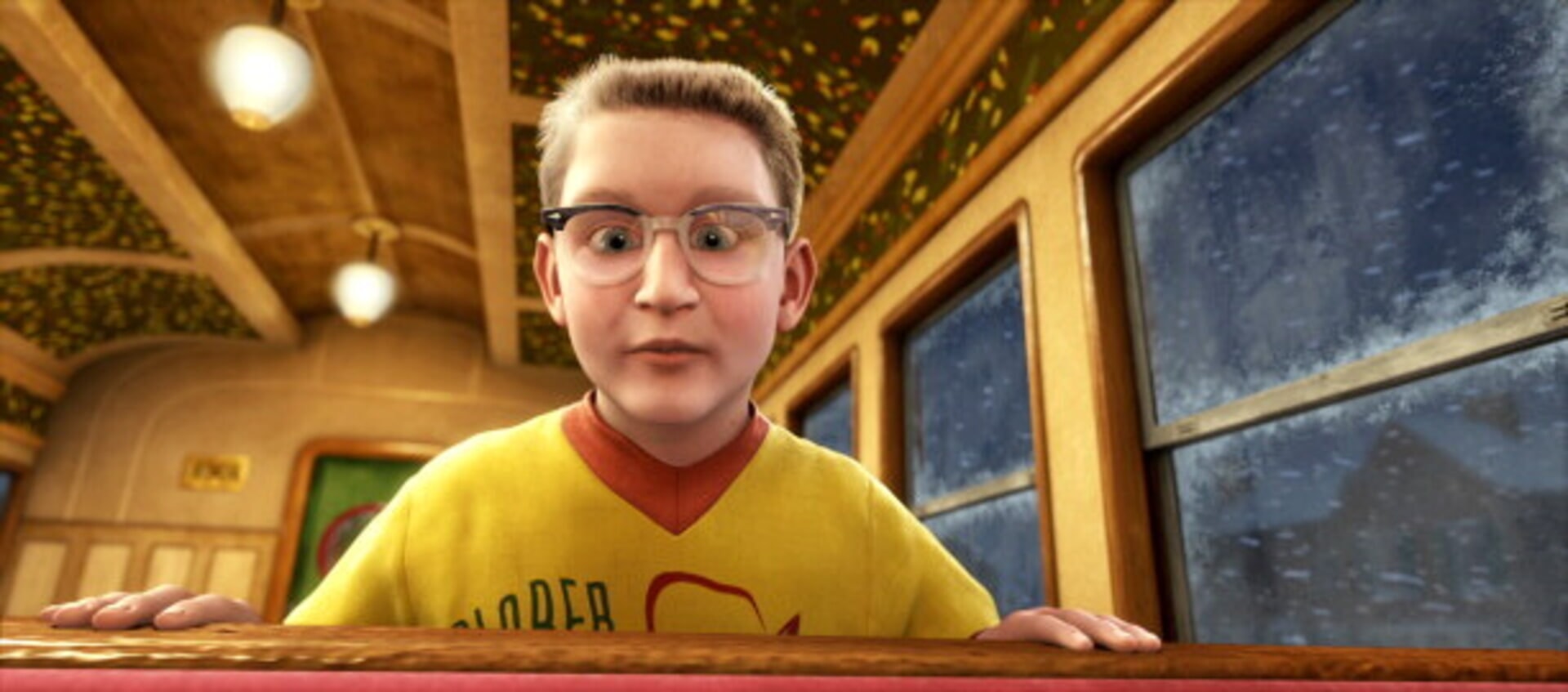
He’s the kid you love to hate. Honestly, if you grew up watching the 2004 motion-capture classic The Polar Express, you probably had a visceral reaction to the know it all polar express character the second he stepped onto the screen. He’s got those yellow-tinted glasses. He’s got that nasal, congested voice provided by Eddie Deezen. He’s basically the human embodiment of a "well, actually" Reddit thread before Reddit was even a thing.
But here’s the thing about the "Know-It-All"—who is officially credited only as "Know-It-All" or "Steamer"—he is the most misunderstood character in the entire Robert Zemeckis filmography.
Most people see him as a nuisance. They see a kid who interrupts the Hero Boy to explain the mechanics of a Baldwin 2-8-4 S-3 class steam locomotive or the specific logistics of the North Pole's geography. We're conditioned to find him annoying because he lacks "Christmas spirit," which in this movie usually translates to "stop asking questions and just believe." Yet, when you look at the facts of the story, the Know-It-All isn't just a plot device. He’s the only one actually paying attention.
The Reality of the Know It All Polar Express Character
Let’s get real about the performance. Eddie Deezen is a legend. You might remember him from Grease or Dexter’s Laboratory. He has spent his entire career playing this specific archetype: the high-strung, hyper-fixated nerd. In The Polar Express, his character serves as a foil to the Hero Boy’s skepticism. While the Hero Boy is struggling with the existential reality of Santa, the Know-It-All is obsessed with the technical reality of the world around him.
He is the kid who memorized the encyclopedia. He knows that the train is a Berkshire 1225. He knows that the North Pole is technically at the center of the Arctic Ocean.
Is he smug? Yeah. Absolutely. But let's look at his first big scene. He’s explaining the train’s braking system. While the other kids are staring blankly into the middle distance, he’s trying to understand how a massive iron machine is hurtling through a snowy neighborhood without waking up the entire county. He represents the analytical mind in a world of magic.
Why the Animation Makes Him So Uncanny
There is no escaping the "Uncanny Valley" conversation when talking about this movie. Back in 2004, the motion capture technology was groundbreaking but deeply flawed. It made the know it all polar express look... well, a bit creepy. His eyes don’t quite focus. His skin has a slightly waxy, plastic sheen that makes his smug expressions feel even more punchable than they probably would be in live-action.
This was the first film entirely captured using this method. Sony Pictures Imageworks handled the heavy lifting. The goal was to make Chris Van Allsburg’s illustrations come to life, but the result was a cast of characters that looked like they were made of marzipan and haunted by Victorian ghosts.
The Know-It-All suffers the most from this because his facial expressions are so extreme. When he’s lecturing the Hero Girl about the hot chocolate or the "Forfeit" rule, his face contorts in ways that feel slightly inhuman. It adds to the alienation. You don't just want him to be quiet; you want him to stop looking at you with those unblinking eyes.
The Baldwin 2-8-4 Connection
Wait, let's talk about the train for a second. This is where the Know-It-All actually earns his keep. He identifies the engine as a "Baldwin 2-8-4 S-3 class steam locomotive built in 1941."
He’s not making that up.
The production team actually used the Pere Marquette 1225 as the reference for the film. It was a real locomotive stored at the Steam Railroading Institute in Owosso, Michigan. They recorded the actual sounds of the 1225—the whistle, the chugging, the steam release. When the Know-It-All is rattling off these specs, he is providing the audience with the most factual, grounded information in the entire movie. He is the anchor to reality.
Without him, the movie is just a fever dream about a magic train. With him, it's a movie about a magic train that specifically uses a 2-8-4 wheel arrangement. That matters to a certain kind of person. It probably matters to you if you're the type to look up the "know it all polar express" in the first place.
The "Forfeit" and the Lessons Learned
There is a moment on the train where the Know-It-All tries to take charge. When the Hero Girl loses her ticket, he’s the first one to scream "Forfeit!" He’s obsessed with the rules. To him, the world operates on a strict set of protocols. If you lose your ticket, you are off the train. Period.
It’s a harsh worldview for a kid. It suggests he’s someone who has been raised in a system where performance and adherence to rules are the only things that matter. While the Hero Boy needs to learn to "Believe" and the Hero Girl needs to learn to "Lead," the Know-It-All’s ticket is punched with a very specific word at the end: Learn.
Specifically, he needs to learn humility.
By the time they reach the North Pole, he’s still trying to explain things away, but he’s starting to realize that his books didn't prepare him for a city made of gingerbread and elves. When Santa finally appears, the Know-It-All is silenced. Not because he’s scared, but because he’s finally encountering something that his technical manuals can’t explain. It’s the ultimate character arc for a pedant.
The Cultural Legacy of the Meme
In the last few years, the know it all polar express has transitioned from a minor movie character to a massive internet meme. You see him on TikTok and Twitter (X) constantly. He’s the face of the "Um, actually" guy.
Why did he specifically become the meme?
It’s the combination of the voice and the glasses. It’s so specific. It’s so recognizable. Everyone has met this person. Maybe you are this person. The meme works because it taps into a universal truth: there is nothing more annoying than someone being right in the most irritating way possible.
He’s the guy who tells you that "Frankenstein was the scientist, not the monster." He’s the guy who corrects your pronunciation of "gyro." He is the Know-It-All, and he is eternal.
Comparing the Movie Kid to the Book
If you go back and read the original 1985 book by Chris Van Allsburg, you’ll notice something interesting. The Know-It-All doesn’t really exist there. The book is sparse. It’s atmospheric. It’s quiet.
The movie had to expand a 32-page picture book into a 100-minute feature film. To do that, they needed conflict. They needed a group of kids with distinct personalities to fill the seats. They created the "Lonely Boy" (Billy), the "Hero Girl," and our bespectacled friend.
Adding the Know-It-All was a stroke of genius by the screenwriters (Zemeckis and William Broyles Jr.). He provides the friction. Without him, the journey is just a series of pretty pictures. He gives the other characters something to react against. He makes the Hero Boy’s skepticism look different. The Hero Boy is a skeptic because he’s afraid of being tricked; the Know-It-All is a skeptic because he thinks he’s already figured it all out. Those are two very different types of doubt.
Was He Actually a Bad Kid?
Honestly? No.
Think about it. He’s helpful, even if he’s loud about it. He tries to help find the ticket (even if he’s also shouting about forfeits). He follows the group. He doesn’t wander off and put people in danger like Billy or the Hero Boy often do. He stays on the path. He’s just... a lot.
In the final act, when Santa is handing out the first gift of Christmas, the Know-It-All is genuinely excited. He isn't bitter that he didn't get chosen. He’s just happy to be there. For a kid who spent the whole movie trying to prove he was the smartest person in the room, he ends the film being perfectly happy just being a kid in a crowd.
That’s a big growth moment that most people miss because they’re too busy laughing at his voice.
How to Handle Your Own Inner "Know-It-All"
We all have a bit of this kid in us. It’s the part of us that wants to correct people when they get a movie fact wrong or when they misquote a statistic. In the age of instant information, the "know it all polar express" energy is at an all-time high.
The lesson of the character isn't that knowledge is bad. Knowledge is great! The world needs people who know how Baldwin 2-8-4 S-3 locomotives work. We need people who understand the mechanics of the world.
The lesson is about how you share that knowledge.
If you're constantly looking for the "forfeit"—constantly looking for the mistake in others—you miss the magic of the ride. You miss the hot chocolate. You miss the view from the top of the mountain.
Actionable Takeaways for Your Next Rewatch
Next time you sit down to watch The Polar Express, try to view the Know-It-All through a different lens. Instead of just seeing an annoying kid, look for these specific details:
- Listen to the Specs: Check the facts he spouts against the real-world Pere Marquette 1225. You’ll find he’s 100% accurate.
- Watch His Eyes: Observe the "Uncanny Valley" effect during his "Forfeit" speech. It’s one of the most technically complex (and slightly terrifying) bits of animation in the film.
- Notice the Silence: Look for the moment he stops talking at the North Pole. It’s the first time in the movie he’s genuinely speechless.
- The Ticket Lesson: Pay attention to the word "Learn" on his ticket. It’s not a punishment; it’s a directive. It’s Santa telling him that there is more to the world than what is written in books.
The know it all polar express character is a masterpiece of character design because he is so successful at being exactly what he’s supposed to be. He’s the friction that makes the story move. He’s the logic in a world of dreams. And let’s be honest—without him, who would have told us about the braking system? We’d all just be sitting there in ignorance while the train barreled toward the North Pole.
So, give the kid a break. He’s just a nerd who wants to make sure everyone knows the difference between a conductor and an engineer. There are worse things to be.
Moving Forward With This Knowledge
If you’re a fan of the film or just a student of animation history, the best thing you can do is dive into the "Making Of" documentaries regarding the motion capture process. Understanding how they mapped Eddie Deezen’s frantic movements onto that digital model explains a lot about why the character feels so energetic and, at times, overwhelming.
Check out the Steam Railroading Institute’s archives if you want to see the real locomotive that inspired the Know-It-All’s obsession. It turns his "annoying" facts into a fascinating piece of railroad history that still exists today. You can even ride the "North Pole Express" in Michigan, which uses the 1225 engine, giving you a chance to be the know-it-all in your own friend group. Just maybe keep the "forfeit" comments to a minimum.