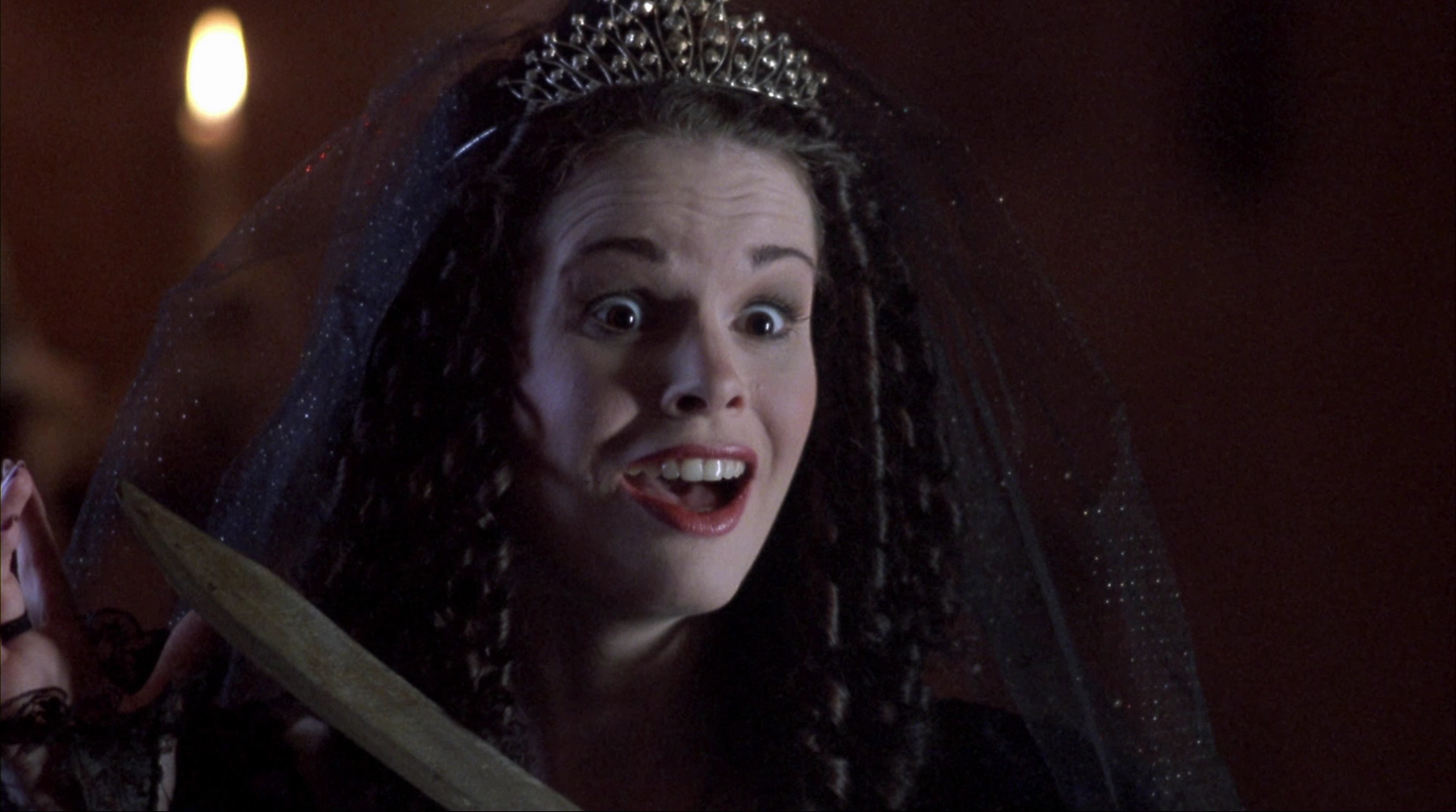
Halloween in the late eighties was a weird, sticky time for horror. You had Freddy cracking puns and Jason hacking through Manhattan, but then came Angela Franklin. She wasn’t just another slasher. She was the weird girl. The goth girl. The girl who invited everyone to a mortuary and ended up eating her friends. Honestly, if you grew up watching Night of the Demons on a fuzzy VHS tape, Angela probably still haunts your specific brand of nightmares.
She's different.
Most horror icons feel like machines—unstoppable, silent, or endlessly quippy. But Angela, especially the version we got in the 1988 original, felt like a real person who just happened to invite a demon into her soul during a party game gone wrong. Angela Night of the Demons isn't just a character; she’s an entire vibe that defined the "party horror" subgenre.
The Goth Girl Who Started It All
Before the yellow eyes and the jagged teeth, Angela was basically the prototype for every alternative girl you knew in high school. Played by Amelia Kinkade, Angela is the one who organizes a Halloween bash at Hull House, an abandoned funeral parlor. Bad move? Totally. But you have to respect the commitment to the aesthetic.
The movie kicks off with her and her best friend Suzanne (the legendary scream queen Linnea Quigley) leading a group of tropes—the jock, the jerk, the final girl—into a house with a literal "cursed" reputation. It’s classic 80s setup.
The seance scene is where everything shifts. Angela isn't trying to die; she's trying to have fun. But when the demon wakes up in the crematorium, it doesn't just kill her. It makes her the host. That's the key to why she works: she’s the leader of the pack even after she loses her humanity.
That Dance (You Know the One)
We have to talk about the dance. If there is one single reason Angela Night of the Demons remains a legend, it’s the strobe-light sequence set to "Stigmata Martyr" by Bauhaus.
It is deeply unsettling.
Amelia Kinkade was a professional dancer before she was a horror icon, and it shows. Director Kevin Tenney basically let her improvise the whole thing. It’s jerky, hypnotic, and feels genuinely "wrong" in a way that CGI can never replicate. She’s wearing this tattered black wedding dress, her movements are fluid yet jagged, and the Bauhaus track just hammers home that 80s goth-rock dread. It’s one of the few times a dance sequence in a horror movie actually adds to the terror instead of being a goofy distraction.
Why Amelia Kinkade Is Irreplaceable
A lot of people don't realize that Kinkade is the only person to appear in all three of the original films. She’s the glue. While other franchises swapped out actors like they were changing lightbulbs, Kinkade stayed.
She brought a weirdly playful, almost Freddy-esque humor to the role in the sequels, but she never lost that underlying creepiness. Fun fact: she’s actually the niece of Rue McClanahan from The Golden Girls. Imagine Blanche Devereaux visiting the set of a movie where her niece is ripping out hearts and turning teens into demons. It actually happened—there are photos of Rue on set, looking absolutely delighted by the gore.
The Evolution of the Demon
By the time we got to Night of the Demons 2 and Night of the Demons 3, Angela had fully embraced being the "Queen of the Demons." The rules of her existence became a bit more defined:
- She can only really "manifest" on Halloween.
- She’s bound to the property of Hull House (usually).
- She’s weak to things like holy water and, interestingly, running water.
In the second film, we find out she has a sister, Melissa (often called "Mouse"). This added a weird layer of family tragedy to the carnage. Angela isn't just a monster; she’s a corrupted memory of a big sister. The makeup also evolved. Kevin Yagher did the effects for the first film, creating that iconic "snaggletooth" look that balanced beauty and repulsion. By the third movie, the budget was lower and the look changed, but Kinkade’s performance kept it grounded.
What the Remake Got Wrong (and Right)
In 2009, they remade the original with Shannon Elizabeth as Angela (renamed Angela Feld). It wasn't "bad," but it missed the raw, punk-rock energy of the 1988 version. The remake tried to explain too much. The original thrived on the fact that Hull House was just bad. There was an underground stream, a history of murder, and a demon that just wanted to party.
The 2009 version felt polished. The original felt like it was filmed in a basement that smelled like clove cigarettes and fake blood. That’s the atmosphere Angela belongs in.
Why She Still Matters in 2026
Horror fans are currently obsessed with "Elevated Horror," but there’s a massive resurgence in the "neon-goth" aesthetic of the late 80s. Angela is the patron saint of that movement. She represents the fear of the "outsider" finally pushing back.
She isn't a mindless killer like Michael Myers. She’s seductive, she’s funny, and she’s deeply, deeply mean. When she rips a guy's tongue out or uses her own tongue to impale someone, it's done with a smirk. That personality is why she’s ranked in lists of the greatest horror villains of all time, often sitting comfortably alongside the big boys like Pinhead or Chucky.
Your Night of the Demons Watch List
If you want to actually understand the hype, you have to watch them in a specific way. Don't just binge them; appreciate the decline and the weirdness.
- The Must-Watch: The 1988 original. Watch it for the Bauhaus dance and the lipstick scene. It’s a masterpiece of low-budget ingenuity.
- The Fun Sequel: Night of the Demons 2 (1994). It leans harder into the comedy and the "monster movie" tropes. The effects are actually pretty solid here.
- The Completionist Choice: Night of the Demons 3. It’s a bit of a mess, but Kinkade is still having the time of her life.
- The Skip: The 2009 remake. Unless you really love the cast, it doesn't add much to the Angela mythos.
To really get the full experience, look for the Scream Factory Blu-ray releases. They have incredible behind-the-scenes features that explain how they pulled off those practical effects on a shoestring budget. Angela Franklin proved that you didn't need a massive studio budget to create a character that would still be talked about nearly forty years later. You just needed a black dress, some yellow contacts, and a really good playlist.
Next time you're at a party and someone suggests a seance, maybe just go get another drink instead. Unless you look as good in a black wedding dress as Angela does.
Actionable Insights for Horror Fans:
- Track Down the Soundtrack: If you want that specific 80s horror vibe, find the original soundtrack. "Stigmata Martyr" is the standout, but the synth score by Dennis Michael Tenney is underrated.
- Follow the Creator: Director Kevin Tenney is still active in the horror community and often shares bits of trivia about the "Hull House" mythology.
- Convention Circuit: Amelia Kinkade still occasionally makes appearances at horror conventions. If you get a chance to see her, she’s known for being incredibly kind to fans—a sharp contrast to her on-screen persona.
- Check Out the Practical Effects: If you’re a filmmaker, study the transformation scenes in the first two films. They used old-school trickery like air bladders and reverse filming that still looks better than cheap CGI.